
Reviewed · LUANG PRABANG TOURS
Luang Prabang: Almsgiving Ceremony Offering
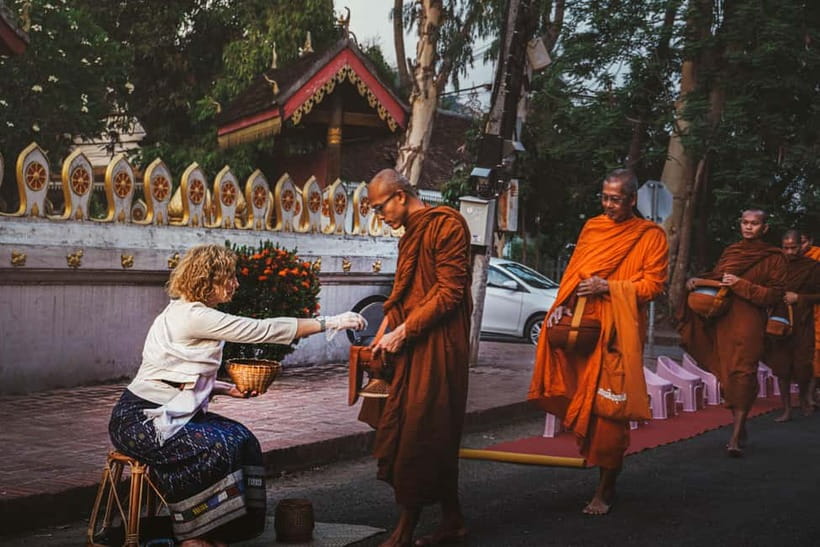
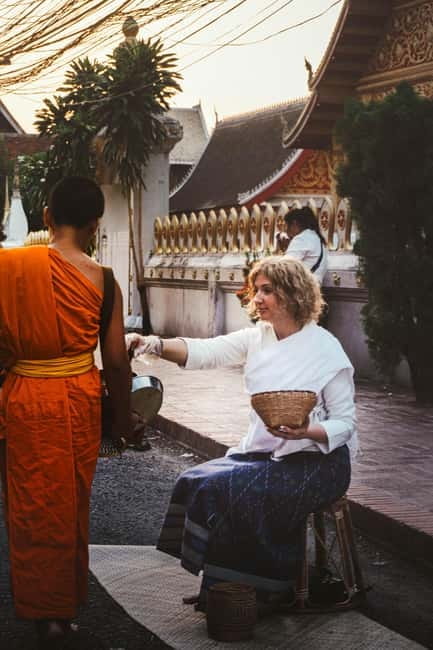
Tak Bat in Luang Prabang is interesting because it is both public and personal, a daily Buddhist ritual you watch up close while monks move through real neighborhood streets. I love the hands-on offering part, with a traditional set (sticky rice, banana, and snacks) that makes you an active participant, not just a spectator.
I also like how much context you get from the guide, especially when you meet Johnny, who has explained his own Buddhist background and helped translate what you are seeing into something you can actually understand. One possible drawback is that it is early, and you must follow rules closely, like no flash and not touching monks or their alms bowls, plus modest clothing (shoulders and knees covered).
Key things to know before you go
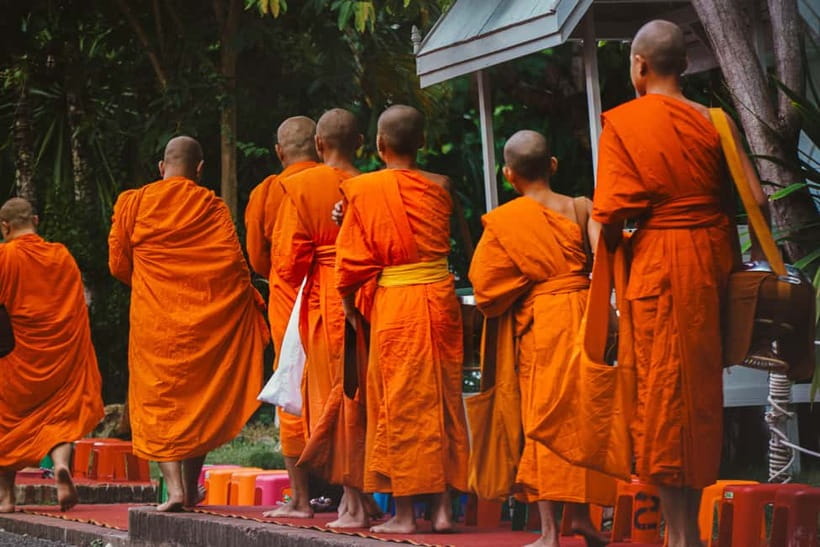
- A real morning ritual: you will watch saffron-robed monks collect offerings as locals and visitors participate
- You get the right tools: a traditional Lao offering set plus a local-style scarf to wear
- Learn while you walk: an English or Thai live guide explains the meaning of Tak Bat
- Photo-friendly but strict: bring a camera, but flash photography is not allowed
- One hour, then a temple: you finish with a nearby temple visit for Buddhist practice context
- Small practical details matter: you will want to dress modestly and keep respectful space around the monks
Tak Bat in Luang Prabang: what the morning almsgiving feels like
Luang Prabang does early mornings well. When you see Tak Bat, the whole town seems to shift into a quieter gear, even though you are still in the middle of everyday streets. Monks in saffron robes walk through the dawn light in a steady flow, and long lines form around them as people prepare food offerings.
What makes it special is that it is not a staged performance. You are watching a daily ritual where food is offered to monks as part of Buddhist practice, and the pace is calm, not rushed. The ceremony has a solemn feel, which is a big reason why so many visitors remember their first minutes vividly.
You will also notice the contrast: the street atmosphere is ordinary, but the actions are focused. People line up with baskets and carefully prepared items, monks continue forward silently, and you feel like your role is to do things correctly and respectfully, not to make noise or crowd the moment.
Lining up Luang Prabang? These sit well beside it:
- Luang Prabang: Cruise to Pak Ou Caves & Kuang Si Waterfalls
★ 5.0 · 1,769 reviews - Luang Prabang: Cruise to Pak Ou Caves & Kuang Si Waterfalls
★ 4.8 · 1,360 reviews - Half Day Mekong Cruise to Pak Ou Caves (Morning / Afternoon)
★ 4.6 · 290 reviews
How the offering set works (sticky rice, banana, and snacks)
You do not show up empty-handed. You get a traditional Lao offering set, typically sticky rice with a banana and some snacks. This matters because the ceremony is about offering food in a culturally expected way. If you bring your own random items, you can accidentally break the rhythm or cause confusion.
In practice, the guide helps you understand how to participate respectfully with what you have been given. You are not expected to improvise. Instead, you focus on the act itself: preparing your offering, moving when you are supposed to move, and keeping your attention on what is happening around you.
The provided scarf is also part of doing this right. It helps you blend in with the modest, respectful look the ceremony asks for. More than anything, it signals that you are there to participate thoughtfully, not just to take photos and wander.
Timing and what you’ll actually do during the 1 hour
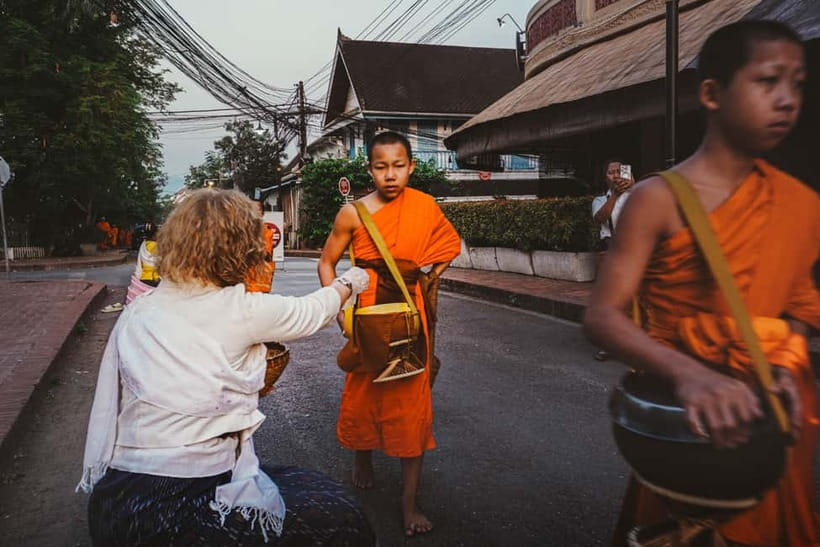
This experience runs for about 1 hour, starting in the early morning when the ceremony begins and you can see monks in the process of collecting offerings. It is short enough to fit well into a Luang Prabang itinerary, but long enough for you to experience the rhythm, not just the first few seconds.
Expect the flow to look like this. First, you get brief context about Tak Bat and morning almsgiving, then you join the line and watch the monks pass by. Because it is a daily ritual, the movement is steady. You will have time to observe how people position themselves, and you will feel the pace shift from arrival energy to quiet focus.
After the ceremony, you do not just walk away. You continue to a nearby temple, where your guide helps you make sense of what you saw. This is a big deal for value, since it turns the experience from a photo stop into something you can connect to Buddhist practices.
Meeting in Luang Prabang: L’Elephant and finding the calm spot
Your starting point is L’Elephant, and that is where the experience begins. From there, you will head toward the area where the ceremony is observed.
What I like about the way this is set up is that it can feel calmer than the busiest spectacle-style tourist spots. In one past experience, the group met near Wat Nong temple on a quiet side road, away from the biggest general crowd. The result was a more spiritual atmosphere, because you are less jostled and you can pay attention.
That said, logistics still matter. If you arrive late or distracted, you can miss the moment when people start lining up. I recommend you build in a bit of buffer time and keep your camera ready, since the early light and monk processional timing does not wait.
Slow the Luang Prabang day right down:
- Luang Prabang: UNESCO World Heritage City Highlights Tour
★ 4.6 · 201 reviews - Luang Prabang: Afternoon Kuang Si Waterfalls & Sunset Cruise
★ 4.6 · 158 reviews - Luang Prabang: Evening Cooking Class & Local Baci Ceremony
★ 4.9 · 151 reviews - Luang Prabang: Kayak Tour to Pak Ou Caves
★ 4.4 · 115 reviews
Behavior rules that keep the ceremony respectful
The ceremony has clear boundaries, and they are not optional. You should dress modestly, with shoulders and knees covered, and wear the scarf if it is provided for your group. This is not about fashion, it is about showing respect in a sacred public space.
You also need to follow the rules around photography. Flash photography is not allowed, so plan to shoot with natural light. If you want better photos, use steadier hands, hold your camera closer to your body for stability, and lean into slower shutter settings only if your camera handles them well.
Most important: do not touch the monks or their alms bowls. Even if you feel excited, keep your hands to yourself. The point of the ceremony is that the monks and participants each have their place, and touching breaks that boundary immediately.
The guide experience: what you gain from an English or Thai host
A big part of why this tour works is the live guide. You get an English or Thai guide who explains the cultural and spiritual significance of Tak Bat. This matters because almsgiving is easy to watch, but harder to interpret unless someone helps you connect the actions to the meaning.
In strong past experiences, guides like Johnny stood out because they explained Buddhism through real personal understanding. One account noted that Johnny had been a monk for about 10 years, which gave extra depth and clarity. Another guide was described as very informative and helpful with Buddhist context.
The practical takeaway for you is simple. If you want more than a visual moment, book this specifically because you are paying for guidance during the ceremony and during the temple visit afterward. Without that, you can still watch Tak Bat, but you may miss why people do what they do.
Temple visit after Tak Bat: why the follow-up matters
The ceremony is powerful on its own, but the temple stop is what turns it into a fuller understanding. After you finish offering and observing, you visit a nearby temple for deeper insight into Buddhist practices.
This second step helps you connect two pieces. You see what is happening in the street, then you learn how that fits into broader Buddhist life and practice. If you are the kind of traveler who likes to understand the why behind a ritual, this temple time is the payoff.
It is also a good reset after the early morning focus. The ceremony is movement and line-ups, but a temple visit is slower, more reflective, and usually easier to appreciate without feeling you need to rush.
Price and value: is $25 for one hour worth it?
At $25 per person for a roughly one-hour experience, the value comes down to what is included and what you avoid.
You get:
- A traditional Lao offering set (sticky rice, banana, snacks)
- A local-style scarf for the ceremony
- Live guide support in English or Thai
- A temple visit after the ceremony
The biggest value is not the ceremony itself. You could theoretically watch something similar without paying. The value is in being correctly prepared for participation, getting cultural context in real time, and having the ceremony followed by a temple explanation so you do not leave with only half the story.
One caution: transfer is not included. That means your total day cost depends on how you plan to reach the meeting area and the ceremony spot. If you are already staying nearby, it is easy. If you are farther out, factor in your transport plan before you decide.
Who this tour is best for, and who should skip it
This is a good match if you want a respectful, structured way to witness Tak Bat and you enjoy early starts. It is also a nice fit for travelers who care about cultural context, since the guide is there to explain what the ritual means.
It is wheelchair accessible, which is a meaningful plus. Still, the early morning environment and street setting can be uneven or crowded at times, so go in with realistic expectations about how comfortable the walking will be.
It is not suitable for everyone. The tour is not recommended if you have altitude sickness concerns, and it is not suitable for babies under 1 year. If either applies to you, choose a different Luang Prabang activity that fits your needs better.
Practical photography tips for serene dawn moments
If you love photos, this is one of those rare moments where you can capture quiet beauty without chasing staged views. But remember: no flash photography. So your camera settings matter.
Here are safe, low-stress ways to improve your results:
- Get your exposure ready before people start moving through the area
- Keep your camera on, ready, so you do not miss the exact second monks pass
- Focus on faces and hands, since that is where the offering action shows most clearly
- Take fewer shots with better framing, instead of rapid-fire bursts
Also remember that the ceremony is a sacred moment. If you find yourself moving too close or blocking someone, step back and wait. Respect keeps the atmosphere calm, and it usually leads to better photos anyway.
One honest caution: what can go wrong and how you prevent it
Even good tours can have hiccups. A small number of past bookings reported issues like not finding the guide or the guide not showing up. That does not mean it will happen, but it does tell you to take one simple step.
Before the morning starts, confirm the meeting details clearly and save them on your phone. If you are using the app, screenshot the meeting point. Then arrive early enough that if something feels off, you still have time to sort it out calmly.
Should you book this Luang Prabang Tak Bat offering experience?
If your goal is a respectful, guided way to witness Tak Bat, I think this is an easy yes. The combination of the hands-on offering set, the scarf, the no-flash rules made clear, and the temple visit afterward turns it into more than a quick photo stop.
I would skip it if you cannot handle very early mornings, do not want to follow strict etiquette, or prefer activities with no ceremonies at all. Also, since transfer is not included, double-check how you will get to the meeting area from your hotel.
When it is done right, you walk away with two things: serene images of dawn in a UNESCO town, and a clearer sense of why people offer food to monks each day.
The newest Luang Prabang reviews
- A Relaxing Day at the Kuang Si Falls★ 4.5 · 3 reviews
- Sunset Cruise in Luang Prabang with Live Performance★ 4.5 · 3 reviews
- Private Luang Prabang City Tour★ 5.0 · 3 reviews
- Luang Prabang Night-time Explorer★ 3.5 · 3 reviews
- The Namkhan – Traditional Lao Bamboo Weaving★ 5.0 · 4 reviews
- Luang Prabang Cooking, Pottery & Candle Experience★ 5.0 · 4 reviews
- Private Tour: Half-Day City Tour of Luang Prabang★ 4.5 · 4 reviews
- Dine and Cruise on Mekong River★ 4.0 · 4 reviews
Luang Prabang Tours, compared.
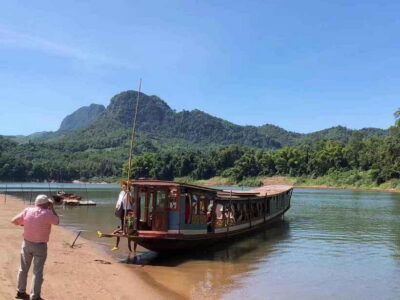

Half Day Mekong Cruise to Pak Ou Caves (Morning / Afternoon)
Read our review →


Browse the lists this tour appears in